

German Company ALGATEC Develops Lithium-Free Battery Technology Targeting 1,000 Wh/kg Energy Density
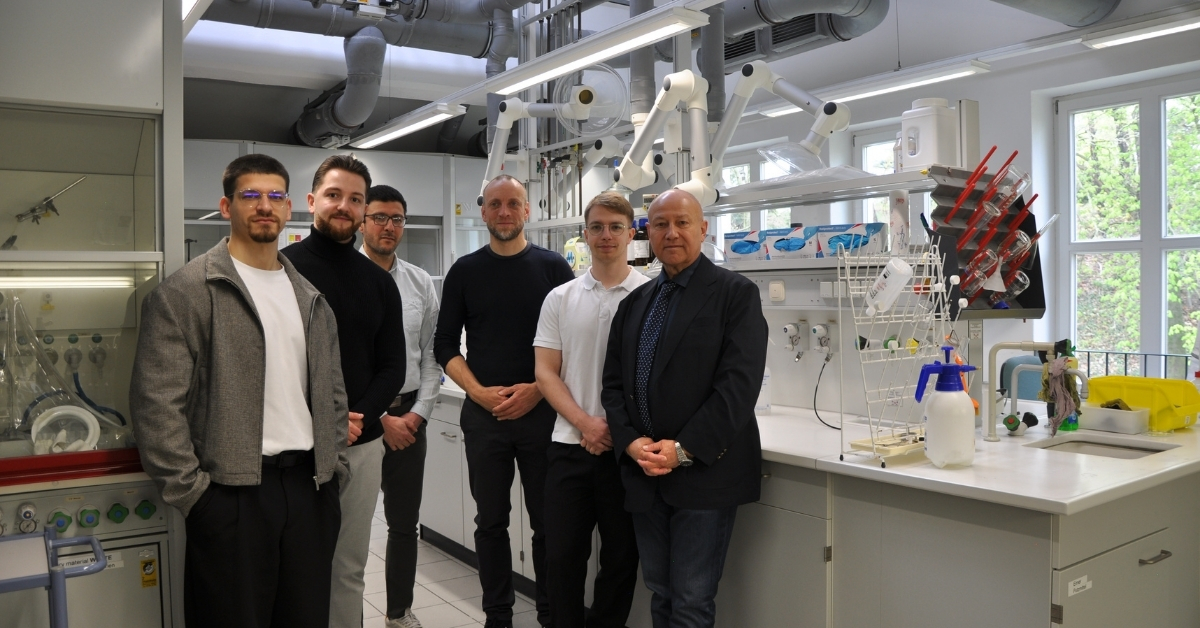
From left to right: Mikita Chystou, Marvin Heide, Dr. Mohammadjafar Momeni, Dr. Tilmann Leisegang, Steven Scholz, and Rainer Ruschke.
ALGATEC logo
Self-funded FineGap and BlackGap systems aim to deliver non-flammable, lithium-free energy storage using raw materials available in Europe
SCHWARZHEIDE, BRANDENBURG, GERMANY, August 6, 2026 /EINPresswire.com/ -- While governments are investing billions in gigafactories and the global race for lithium continues to intensify, one company in the German states of Brandenburg and Saxony has been pursuing a completely different approach to battery technology for more than a decade.ALGATEC is developing two battery systems, FineGap and BlackGap, based on new material concepts. The goal is to achieve higher energy density, a non-flammable cell chemistry, and the complete elimination of lithium.
These figures stand out:
The company has already invested approximately €2.7 million of its own funds into the development of FineGap. In laboratory testing, the patented metal-carbon system demonstrated a performance increase of around 650% compared with the reference systems examined. The developed active material has already been successfully validated in the intended battery cell type.
At the same time, ALGATEC is pursuing a second approach with BlackGap: a lithium-free metal-air battery based on raw materials that are readily available in Europe. The targeted technical specifications are up to 1,000 Wh/kg of specific energy and up to 2,700 Wh/l of energy density.
For comparison, today's lithium-ion batteries typically achieve 100 to 300 Wh/kg of specific energy, depending on cell chemistry and application.¹ Future lithium-ion cells are generally expected to reach energy densities of only up to 850 Wh/l as realistic development targets.²
Since 2014, an interdisciplinary team of entrepreneurs, technology experts, and scientific partners has been working on both technologies. BlackGap is also receiving public funding through Germany's Central Innovation Programme for SMEs (ZIM).
These battery technologies are now attracting attention well beyond Germany's borders. Interest extends as far as the United Arab Emirates, where the developments from Brandenburg and Saxony are also being closely followed.
The real question is therefore no longer whether new battery technologies are needed.
The question is why developments like these have received so little attention so far.
¹ Hippauf, F. (2025): Lithium Batteries – Lithium Secondary Batteries – Lithium All-Solid State Battery | Inorganic Solid-Electrolyte Cells, in: Encyclopedia of Electrochemical Power Sources, 2nd Edition.
² Fraunhofer ISI (2022): Development Perspectives for Lithium-Ion Battery Cell Formats, pp. 6 and 28.
Marvin Heide
ALGATEC Handels UG (haftungsbeschränkt) & Co. KG
+49 172 6816152
m.heide@algatec.com
Legal Disclaimer:
EIN Presswire provides this news content "as is" without warranty of any kind. We do not accept any responsibility or liability for the accuracy, content, images, videos, licenses, completeness, legality, or reliability of the information contained in this article. If you have any complaints or copyright issues related to this article, kindly contact the author above.
